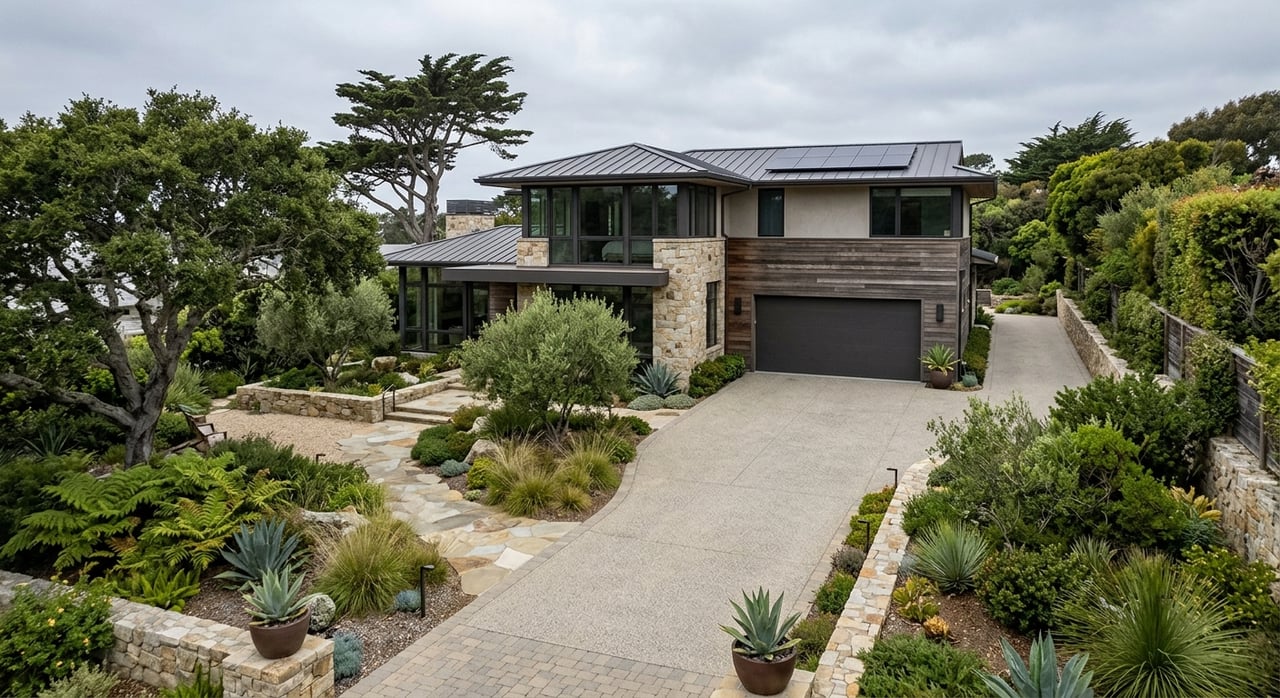
Wondering why one Carmel home commands a premium while another, just blocks away, lands at a very different number? In Carmel, value is rarely about square footage alone. If you are buying, selling, or simply trying to understand this market, it helps to know how location, land, design, and local rules all shape pricing. Let’s dive in.
Carmel values start with scarcity
Carmel-by-the-Sea has a distinct identity that sets it apart from other coastal markets in Monterey County. The city has long emphasized preserving village character, residential character, coastal access, forest character, and environmental safety through its planning framework. That matters because home values here are tied to place, character, and limited developable land, not just the size of the house.
Recent market data shows just how separate Carmel is from the county at large. Over the three months ending April 2026, Redfin reported a median sale price of about $3.5 million in Carmel, compared with $946,356 for Monterey County overall. Carmel also had a median of 28 days on market, which shows demand remains strong even in a high-price segment.
For you as a buyer or seller, the takeaway is simple. Countywide averages can offer context, but they do not explain Carmel pricing very well. In this market, small property differences can create major value swings.
Coastal location shapes price
Beach access matters
Carmel Beach is one of the city’s defining amenities, and coastal access is a clear planning priority for the city. Homes with easier access to the beach, stronger views, or a more compelling coastal setting often carry stronger lifestyle appeal. In a place where the coastline helps define the experience of living there, proximity to that asset matters.
That does not mean every property near the water is valued the same way. A home’s setting, privacy, usability, and day-to-day function still play a major role. Buyers often respond most strongly when ocean proximity comes with a livable, comfortable property rather than just a map advantage.
Coastal risk matters too
Carmel’s coastal setting also comes with real constraints. The city is entirely within the California coastal zone and falls under Coastal Commission oversight. Its 2024 coastal adaptation update identifies hazards such as cliff and dune erosion, beach narrowing, wave overtopping, and future threats to infrastructure along Scenic Drive.
That means the strongest coastal value is often found where views and access are balanced with lower uncertainty and better resilience. For sellers, this can affect how buyers view risk and long-term usability. For buyers, it is a reminder to look beyond the view and consider the full property picture.
Lot usability can outweigh lot size
Buildable area affects value
In Carmel, lot size alone does not tell the whole story. The city’s code guidance ties allowable floor area to lot size or buildable area, and for sites of 4,000 square feet or less, the maximum floor area is 45% of lot size. Even then, the stated maximum may not be achievable if the lot has steep slopes, significant trees, or an unusual shape.
This is one reason two homes on similarly sized lots can have very different values. One site may offer straightforward use and improvement potential, while the other may be limited by physical conditions. In Carmel, the land itself is often a big part of the story.
Site coverage rules are broad
Carmel also defines site coverage broadly. Patios, walkways, driveways, decks, steps, gravel, and even hot tubs can count toward site coverage. That can affect how much flexibility a property really offers for outdoor living, parking, or future changes.
For sellers, this means buyers may look closely at what is already on the site and what that means for future options. For buyers, it helps to think beyond the lot dimensions listed in a property profile. Usable space is what often matters most.
Permitting can create or reduce value
Easier projects often attract more interest
Most exterior alterations and site coverage changes in Carmel require design review. The city’s design-study process is intended to make sure changes and new construction fit Carmel’s design traditions. If a property is more than 50 years old, a historic evaluation may also be required before exterior work.
That can create a meaningful gap between two homes that look similar on paper. A property with clean documentation, completed approvals, or improvements already in place may feel more valuable than one with deferred projects and an uncertain approval path. In a market like Carmel, reduced friction can support stronger pricing.
Historic status can work both ways
If a property is officially historic, it cannot be demolished and exterior changes must meet specific standards. Carmel treats historic resources as part of its architectural and cultural identity, which can support appeal for buyers who value character and authenticity.
At the same time, historic review can add time and complexity for buyers who want to remodel quickly. That is why historic status does not automatically raise or lower value. Its impact often depends on the buyer pool and the condition of the home.
Carmel rewards architectural fit
Design consistency matters here
Carmel has a very specific visual character, and the city’s design framework reinforces it. The city emphasizes human-scale buildings, forest character, and sensitivity to neighboring properties. Its remodeling guidance notes that window changes should fit the architecture, with unclad wood windows and external divided lights identified as the standard, while vinyl windows are considered inappropriate.
This helps explain why some homes stand out in Carmel and others feel less compelling. Buyers here are often responding to how well a property fits the setting, not just to interior finishes. A home that feels true to Carmel’s character can appeal more broadly than one that feels disconnected from it.
Condition still plays a major role
Character matters, but condition matters too. Well-restored homes, coherent updates, and thoughtful maintenance can strengthen a property’s pricing story. Deferred maintenance or exterior choices that conflict with local design expectations may narrow the buyer pool.
For sellers, this is where preparation becomes especially important. In Carmel, presentation is not just cosmetic. It is part of showing that the home belongs in its setting and is ready for the next owner.
Trees, parking, and access influence appeal
Carmel’s urban forest adds beauty and identity, but mature trees can also affect what an owner can do with a property. The city’s forest-management materials note that tree trimming or removal may require permits. That means trees can be both an amenity and a constraint depending on the site.
Parking also matters more here than in many buyers expect. City parking materials and the PACT program reflect ongoing local congestion concerns. Homes with better parking, easier access, and a more practical site layout may enjoy a real advantage because they solve everyday challenges buyers will notice quickly.
County trends support Carmel pricing
Monterey County remains a tight housing market overall. Realtor.com reported 1,004 homes for sale in the county in March 2026, a median listing price of $1,137,500, and median days on market of 49, while also classifying the county as a seller’s market. Carmel sits far above that baseline, but the broader supply-and-demand backdrop still helps support pricing.
Buyer demand also appears to reach beyond the immediate area. Redfin’s migration data for October through December 2025 showed that the biggest outside-metro search origins for Carmel buyers were San Francisco, Los Angeles, and Seattle. That suggests Carmel continues to attract relocation and lifestyle-driven interest from larger metro areas.
Supply constraints add another layer. Carmel has a RHNA goal of 349 new housing units for 2023 through 2031, and the city’s housing materials note that development constraints, zoning, design review, fees, and permitting time can affect what gets built and at what cost. In other words, this is not a market where supply can quickly expand to meet demand.
What supports a stronger value story
If you are trying to understand what drives value in Carmel, it helps to focus on a few core themes:
- Location: Proximity to the beach, views, privacy, and access all matter.
- Usability: Buildable area, site layout, and outdoor function can outweigh raw lot size.
- Resilience: Coastal exposure and future uncertainty can influence buyer confidence.
- Architectural fit: Homes that align with Carmel’s design traditions often show more market appeal.
- Permitting friction: Approved improvements and cleaner documentation can reduce buyer hesitation.
- Condition: Thoughtful upkeep and coherent updates help support stronger pricing.
- Practical features: Parking, access, and tree-related constraints can affect daily livability.
For sellers, the strongest pricing strategy usually comes from connecting these factors to recent comparable sales, not from relying on generic upgrades alone. For buyers, understanding these drivers can help you spot the difference between a home that simply looks appealing and one that offers long-term value in this specific market.
In a place as nuanced as Carmel, pricing is never one-size-fits-all. The homes that tend to hold attention and support stronger values usually combine a compelling location with practical usability, architectural coherence, and fewer unknowns. If you want help interpreting how these factors apply to your purchase or sale, Dave Lucas offers calm, local guidance tailored to the Monterey Peninsula.
FAQs
What drives home values in Carmel more than square footage?
- In Carmel, value is often shaped more by location, lot usability, architectural fit, permitting complexity, condition, and coastal setting than by square footage alone.
Does being closer to Carmel Beach always increase a home’s value?
- Usually, beach access and coastal setting help value, but the strongest premium tends to come when proximity is paired with privacy, usable space, good access, and manageable hazard exposure.
Do larger lots always mean higher home values in Carmel?
- No. In Carmel, slope, trees, lot shape, buildable area, and site coverage limits can matter just as much as the raw lot size.
Do historic homes in Carmel sell for more?
- Not automatically. Historic homes can attract buyers who value character and heritage, but added review requirements for exterior changes can also affect how buyers evaluate them.
Why do parking and trees matter for Carmel property values?
- Parking can be a meaningful convenience in Carmel, and mature trees can add beauty while also limiting site changes if permits are required for trimming or removal.
How is Carmel different from the rest of Monterey County’s housing market?
- Carmel operates as a premium micro-market, with a much higher median sale price than Monterey County overall, so county averages often do not capture Carmel’s property-by-property pricing differences.
